

Journey Highlights
- Route: Siem Reap → Angkor’s temple world (with space beyond the crowds)
- Style: Boutique soulful luxury—quiet design-led stays, private guiding, slow pacing, depth over “must-sees”
- Angkor at dawn: First light over ancient stone, birdsong and incense, the feeling of time opening
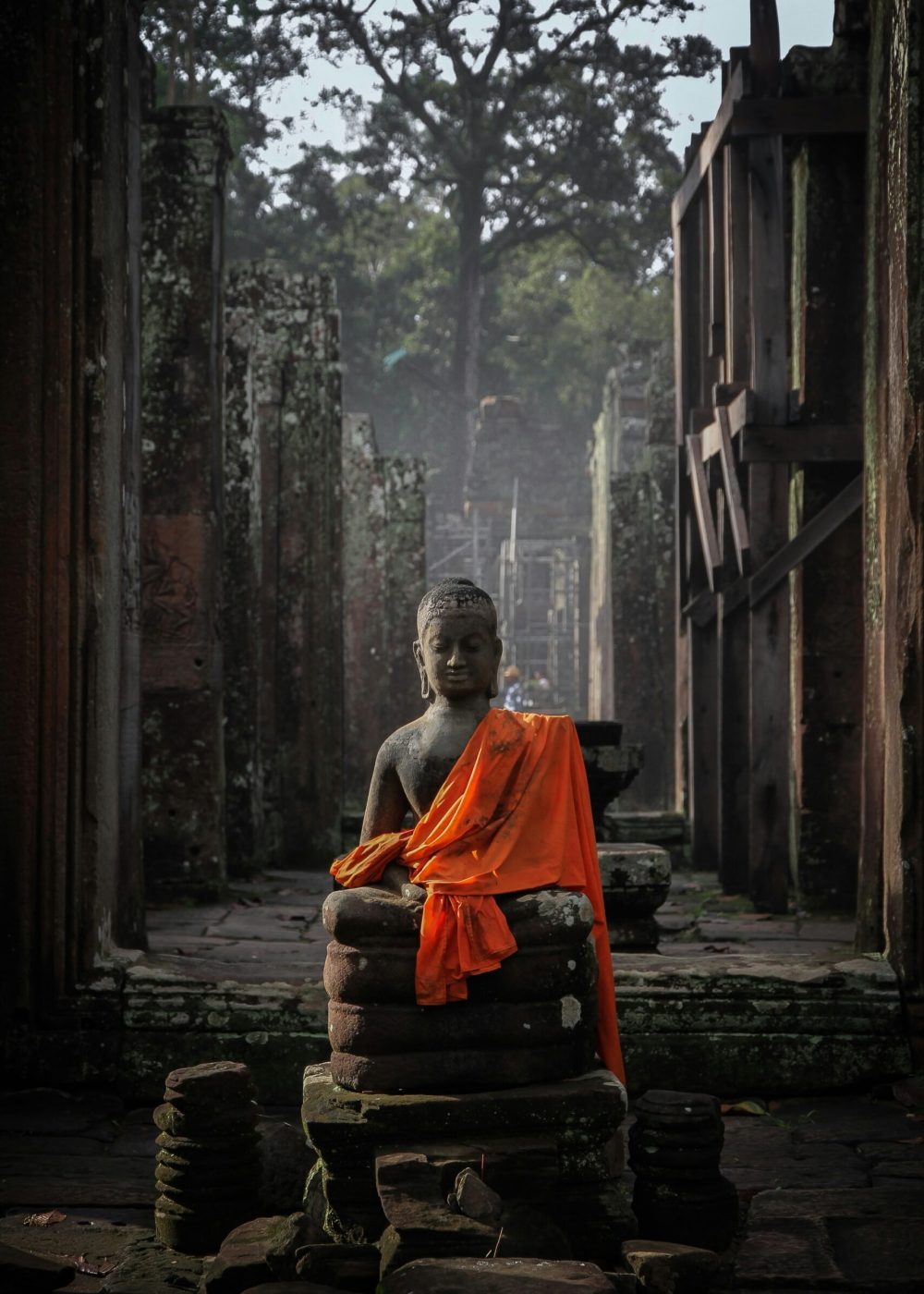
- Hidden temples: Lesser-known ruins reclaimed by jungle, roots gripping walls like memory
- Living culture: Monk blessing, artisan ateliers, market textures, Khmer flavors in intimate settings
- Essence: A temple journey—where awe becomes stillness, and stillness becomes clarity

Cambodia meets you softly.
Not with noise, not with urgency—though the streets can be bright and busy, and the air can carry heat like a warm hand on your shoulder. Cambodia meets you with something older than mood: a kind of gentleness that has survived.
And then there is Angkor.
A temple world hidden in jungle green, built for gods and kings, now belonging to the morning light, the monks, the birds, the roots, and the travelers who arrive with enough quiet inside them to feel it.
This is not a destination for rushing.
This is a place that asks you to slow down until you can hear what stone remembers.
This is a place that asks you to slow down until you can hear what stone remembers.
Siem Reap: The Threshold
You begin in Siem Reap, where life feels both intimate and alive—markets humming, saffron robes moving through the streets, frangipani scent drifting at dusk. Boutique soulful luxury here is not about excess. It’s about atmosphere: a calm room, a shaded pool, a courtyard where you can land in your body again.
Because Angkor is not something you “do.”
It’s something you enter.
It’s something you enter.
You meet your private guide—someone who understands that the most important part of a temple is not the date it was built, but what it awakens in you. The stories are there, yes—empires, cosmology, carvings that map the universe—but the real journey is quieter.
It starts with the way you begin to pay attention.
Angkor doesn’t show you history. It shows you eternity.
Angkor at Dawn: When the World is Still
At dawn, the jungle holds its breath.
The sky pales from ink to pearl, and Angkor appears—not as ruins, but as a presence. Stone lotus towers rise through mist like a prayer you can walk into. You stand in the half-light and feel it immediately: the scale, the devotion, the patience of a civilization that built beauty for something beyond itself.
The first light touches the carvings and they come alive—apsaras dancing in stone, mythic serpents, celestial battles, lotus blooms repeating like a mantra. It’s impossible not to think about time. Not as a concept, but as a force.
Here, time doesn’t feel linear.
It feels layered.
It feels layered.
You walk slowly. You speak less. You begin to understand why people come here and leave changed without knowing exactly what happened.


The Hidden Temples: Where the Jungle Reclaims the Sacred
Beyond the famous silhouettes, Angkor holds quieter sanctuaries.
Temples where the jungle has returned like a gentle takeover—roots spilling over walls, trees gripping doorways, moss softening the edges of stone. Nature and architecture braided together, not in conflict, but in a kind of surrender.
You step through a corridor and feel the temperature drop. The air smells of damp earth and ancient dust. Light filters through leaves in thin, sacred lines. You realize you’re walking through a place that has been prayed in for centuries—by kings, by monks, by villagers, by people whose names are gone but whose intention remains.
Somewhere in the distance, you hear chanting.
Not loud. Not performative. Real.
Not loud. Not performative. Real.
And you feel something in you respond—like a part of you remembers how to be reverent.
Living Cambodia: Devotion in the Everyday
Angkor is not separate from Cambodia. It is its heart, still beating.
You might receive a monk blessing—simple, quiet, deeply human. A string tied around your wrist. A few words spoken softly. Not magic, not theater—just a moment of being seen, and wished well, in a way that feels unexpectedly moving.
You explore artisan ateliers where tradition is kept alive through hands: silk, ceramics, woodwork, stone carving. You taste Khmer flavors that carry brightness and depth—lemongrass, lime, smoke, sweet heat—served in intimate settings where the food feels like care.
And in the markets, you feel the texture of life: baskets of herbs, motorbikes weaving, laughter, the rhythm of a place that holds both history and now without needing to separate them.
Cambodia teaches you that the sacred is not only in temples.
It’s in attention.
It’s in attention.
What Angkor Gives You
Angkor does something rare.
It makes you small—without making you feel insignificant.
It reminds you that humans can build beauty that outlives them. That devotion can be carved into stone. That silence can be a language. That awe can be medicine.
You leave the temple grounds and the world looks slightly different. The light feels more alive. Your mind feels less crowded. You notice details again—the curve of a leaf, the sound of water, the way your own breath moves.
You realize you’ve been living too fast.
And that slowing down is not laziness.
And that slowing down is not laziness.
It’s a return.

This is Vayara
Your Journey Begins Here
At VAYARA, we craft Cambodia journeys that honor Angkor as a living, sacred landscape—private guiding that goes beyond facts, boutique stays designed for calm, and a pace that protects the most important part of the experience: your presence. This isn’t a temple tour. This is a quiet encounter with eternity—held by jungle, stone, and the part of you that’s ready to listen. If Cambodia is calling, we’ll shape the journey that answers it.This isn’t an itinerary. It’s a ritual across three worlds—designed around your rhythm, your depth, your soul’s appetite for beauty and truth. If Morocco is calling, we’ll shape the journey that answers it.


